
--Characteristics--
Native to Britain, Hazel is an attractive, fast-growing multi-stemmed shrub or small tree whose large yellow catkins in February give the first inkling that spring is on its way. With a good rounded shape, and handsome leaves with yellow autumn colour, it is a versatile plant which can be used in a variety of ways. It has excellent wildlife value, and is planted commercially for its nut harvest in autumn.
Site and soil
Hazel will do well in most soils. It tolerates shade well and is often planted as an under-storey to oaks in woodland. Will cope well on coastal sites.
Height and spread
Below are the approximate stages of growth, assuming sited in suitable conditions for this species;
After 10 years: 4m x 2m
After 20 years: 6m x 4m
Leaf and bark
The leaves are large and heart-shaped, with a sharply pointed tip. They are mid green, toothed and coarsely hairy; they turn yellow in autumn. The bark is a shiny grey-brown, peeling off in flakes.
Flower, seed and fruit
The male flowers are yellow catkins, to 6cm long, produced in early February. The female flowers are inconspicuous short red tufts. The shiny brown nuts ripen in September and are produced in small clusters; each nut is held within a green husk.
Uses
Hazel is one of the most important woody plants for coppicing. It can also be used for hedges and screens, as part of woodland under-storey, or grown as a single-stemmed small tree. The flexible coppiced stems are used for thatching spars, making woven screens and fencing, and in the past were used for making wattle and daub walls. Hazel rods are used for water divining. The foliage was once used as fodder for cattle. Hazelnuts are grown commercially for use in various food products; they are a good source of protein.
Wildlife
Although hazel catkins are wind-pollinated, they are a source of early pollen for bees. The larvae of several species of moths and butterflies feed on the leaves and twigs, and small mammals and large birds eat the nuts. Coppicing hazel in woodlands allows wild flowers like bluebells to thrive beneath the trees.
--Plant Protection--
--Planting & Care--
Planting
More commonly used as part of a mixed species within a native hawthorn hedge.
New hedgerows should be planted in two staggered rows 30cm apart.
We recommend a minimum of 5 plants per metre.
Aftercare
Coppicing is carried out over winter. Hazel hedges should be trimmed after flowering in March.
The main reasons for buying protection is to protect the plants against:
- Pests
- Spraying
- Strimming
Pests
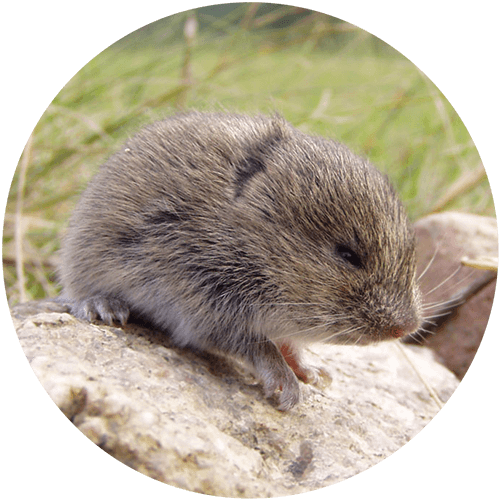
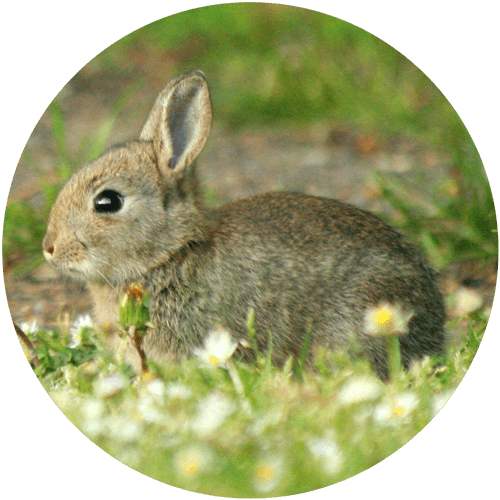
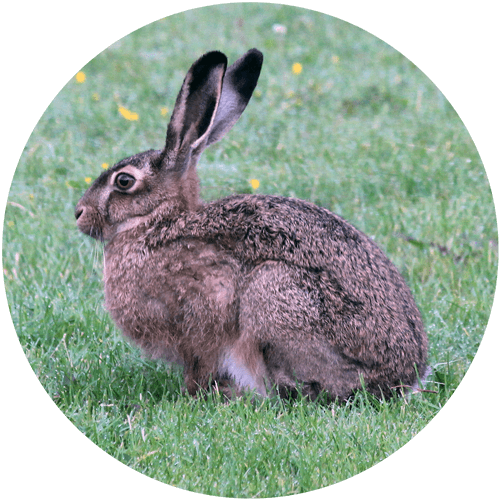
When it comes to deciding what protection to choose the golden rule is to choose the product dependent on which pest you are protecting against. The below will help you in deciding what height of protection you will need.
 |
 |
 |
 |
 |
| Vole, Mice 20cm |
Rabbit 60cm |
Hare 75cm |
Roe Deer, Muntjac 1.20m |
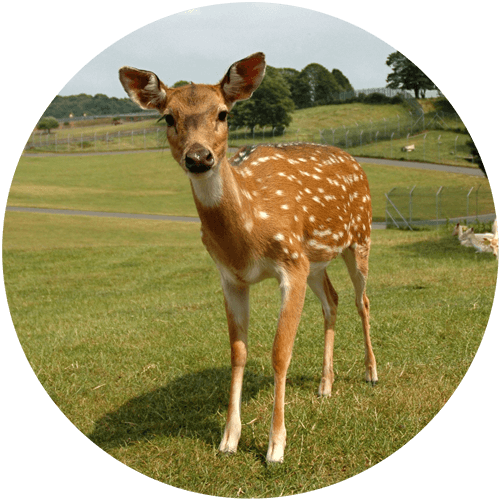
Fallow Deer 1.50m |
| Pest & Minimum Protection Height | Protection Type Where more than one size is listed, the wider diameter protection is recommended for taller, bushier plants. |
Support Required Taller support is recommended for use in sandier, lighter soils and wider/stronger support should be used at exposed sites. |
Vole, Mice 20cm |
Vole Guard 20cm |
None required |
| Pest & Minimum Protection Height | Protection Type Where more than one size is listed, the wider diameter protection is recommended for taller, bushier plants. |
Support Required Taller support is recommended for use in sandier, lighter soils and wider/stronger support should be used at exposed sites. |
| Sorted by price; lowest to highest | ||
Rabbit 60cm |
Spiral Guard 60cm x 38mm, 60cm x 50mm |
Bamboo Cane 90cm x 9-11lbs, 12-14lbs or 14-16lbs |
| Tubex Easywrap 60cm x 50-65mm |
Bamboo Cane 90cm x 9-11lbs, 12-14lbs or 14-16lbs |
|
| Mesh Guard with Spray Shield 60cm x 130mm |
2 x Bamboo Canes 90cm x 9-11lbs, 12-14lbs or 14-16lbs |
|
| Tubex Fruitwrap 60cm x 65-80mm |
Bamboo Cane 90cm x 9-11lbs, 12-14lbs or 14-16lbs |
|
| Tubex Ecostart 60cm x 57-73cm |
Square Sawn Tree Stake 75cm x 25mm, 75cm x 32mm |
|
| Tubex Tree Shelter 60cm x 73-105mm |
Square Sawn Tree Stake 75cm x 25mm, 75cm x 32mm |
|
| Tubex Shelterguard Mesh Tube 60cm x 80-110mm |
Square Sawn Tree Stake 75cm x 25mm, 75cm x 32mm |
|
| Tubex Treeguard Mesh Tube 60cm x 80-110mm |
Square Sawn Tree Stake 75cm x 25mm, 75cm x 32mm |
|
| Tubex Shrub Shelter 60cm x 130-160mm, 60cm x 144-200mm |
Square Sawn Tree Stake 75cm x 25mm, 75cm x 32mm |
|
| Tubex Shrub Shelterguard Mesh Tube 60cm x 130-160mm, 60cm x 170-200mm |
Square Sawn Tree Stake 75cm x 25mm, 75cm x 32mm |
|
| Tubex Treeguard Mesh Tube for Shrubs 60cm x 130-160mm, 60cm x 170-200mm |
Square Sawn Tree Stake 75cm x 25mm, 75cm x 32mm |
|
| Pest & Minimum Protection Height | Protection Type Where more than one size is listed, the wider diameter protection is recommended for taller, bushier plants. |
Support Required Taller support is recommended for use in sandier, lighter soils and wider/stronger support should be used at exposed sites. |
| Sorted by price; lowest to highest | ||
Hare 75cm |
Tubex Easywrap 75cm x 50-65mm |
Bamboo Cane 90cm x 9-11lbs, 12-14lbs, 14-16lbs or 1.20m x 20-22lbs |
| Spiral Guard 75cm x 50mm |
Bamboo Cane 90cm x 9-11lbs, 12-14lbs, 14-16lbs or 1.20m x 20-22lbs |
|
| Tubex Fruitwrap 75cm x 65-80mm |
Bamboo Cane 90cm x 9-11lbs, 12-14lbs, 14-16lbs or 1.20m x 20-22lbs |
|
| Tubex Ecostart 75cm x 57-73mm |
Square Sawn Tree Stake 90cm x 25mm, 90cm x 32mm |
|
| Tubex Tree Shelter 75cm x 73-105mm |
Square Sawn Tree Stake 90cm x 25mm, 90cm x 32mm |
|
| Tubex Combitube 75cm x 73-105mm |
Square Sawn Tree Stake 90cm x 25mm, 90cm x 32mm |
|
| Tubex Shelterguard Mesh Tube 90cm x 80-110mm |
Square Sawn Tree Stake 90cm x 25mm, 90cm x 32mm |
|
| Tubex Treeguard Mesh Tube 75cm x 80-110mm, 90cm x 80-110mm |
Square Sawn Tree Stake 90cm x 25mm, 90cm x 32mm |
|
| Tubex Shrub Shelter 75cm x 130-160mm, 75cm x 144-200mm |
Square Sawn Tree Stake 90cm x 25mm, 90cm x 32mm |
|
| Pest & Minimum Protection Height | Protection Type Where more than one size is listed, the wider diameter protection is recommended for taller, bushier plants. |
Support Required Taller support is recommended for use in sandier, lighter soils and wider/stronger support should be used at exposed sites. |
| Sorted by price; lowest to highest | ||
Roe Deer/Muntjac 1.20m |
Tubex Tree Shelter* 1.20m x 73-105mm, 1.20m x 80-120mm *Not recommended for this species |
Square Sawn Tree Stake 1.20m x 32mm, 1.35m x 32mm |
| Tubex Combitube* 1.20m x 73-105mm *Not recommended for this species |
Square Sawn Tree Stake 1.20m x 32mm, 1.35m x 32mm |
|
| Tubex Shelterguard Mesh Tube* 1.20m x 80-110mm *Not recommended for this species |
Square Sawn Tree Stake 1.20m x 32mm, 1.35m x 32mm |
|
| Tubex Treeguard Mesh Tube* 1.20m x 80-110mm *Not recommended for this species |
Square Sawn Tree Stake 1.20m x 32mm, 1.35m x 32mm |
|
| Galvanised Mesh Tree Guard* 1.20m x 300mm *Not recommended for this species |
Machine Rounded Tree Stake 1.20m x 50mm, 1.50m x 50mm |
|
| Pest & Minimum Protection Height | Protection Type Where more than one size is listed, the wider diameter protection is recommended for taller, bushier plants. |
Support Required Taller support is recommended for use in sandier, lighter soils and wider/stronger support should be used at exposed sites. |
| Sorted by price; lowest to highest | ||
| Fallow Deer 1.50m |
Tubex Tree Shelter* 1.50m x 80-120mm, 1.80m x 80-120mm *Not recommended for this species |
Square Sawn Tree Stake 1.50m x 32mm, 1.80m x 32mm |
| Tubex Combitube* 1.50m x 80-120mm, 1.80m x 80-120mm *Not recommended for this species |
Square Sawn Tree Stake 1.50m x 32mm, 1.80m x 32mm |
|
| Tubex Shelterguard Mesh Tube* 1.50m x 80-110mm, 1.80m x 80-110mm *Not recommended for this species |
Square Sawn Tree Stake 1.50m x 32mm, 1.80m x 32mm |
|
| Tubex Treeguard Mesh Tube* 1.50m x 80-110mm, 1.80m x 80-110mm *Not recommended for this species |
Square Sawn Tree Stake 1.50m x 32mm, 1.80m x 32mm |
|
| Galvanised Mesh Tree Guard* 1.80m x 300mm, 1.80m x 600mm *Not recommended for this species |
Machine Rounded Tree Stake 1.80m x 60mm |
|
Spraying
Tubex tree shelters offer the benefit of not only protecting against animal damage, they also ensure that herbicides do not come into contact with the plants during spraying.
The main reason for spraying is weed control, however, there are other options available to suppress weeds, such as weed control matting.
Strimming
Young plants should be protected from damage caused when strimming. To protect plants solely for strimming, our strimmer guards are the ideal product.